

On May 24th 2024 the FA Europe Network held the first ever pan-European scientific meeting to promote collaboration on Fanconi Anaemia between European countries.
This was the culmination of efforts initiated by Fanconi Hope and the Dutch FA Support Group (the Workgroup of the VKN) with the help of an International grant and strong support from the Fanconi Cancer Foundation, which resulted in the establishment of the FA Europe Network in 2019.
The highly successful event was held at the Saint-Louis Hospital in Paris, a venue of great significance since the world’s first successful human umbilical cord blood transplant was carried out there in 1988.
We were delighted to have Prof Eliane Gluckman, who undertook that first transplant, as our keynote speaker for our event. We were also pleased to have Dr Isis Sroka, the Chief Scientific Officer from the Fanconi Cancer Foundation in the US at the meeting to give the US perspective and to ensure that US and European efforts are fully coordinated.
We were also honoured to hear Dr. Farid Boulad, who has recently retired to live in France after a long and illustrious career in the US, likened the FA Europe Network to the film ‘Field of Dreams’ where Kevin Costner plays a man with a vision to build a baseball pitch in a field in the Irish countryside. He said “If you build it they will come”. So we built the FA Europe Network and the clinicians and scientists came!
In fact, 92 clinicians, scientists and patient support group representatives from 12 countries came together to discuss how to work more closely together in pursuit of our common vision of achieving equal access to optimized care for people across Europe affected by Fanconi Anaemia.
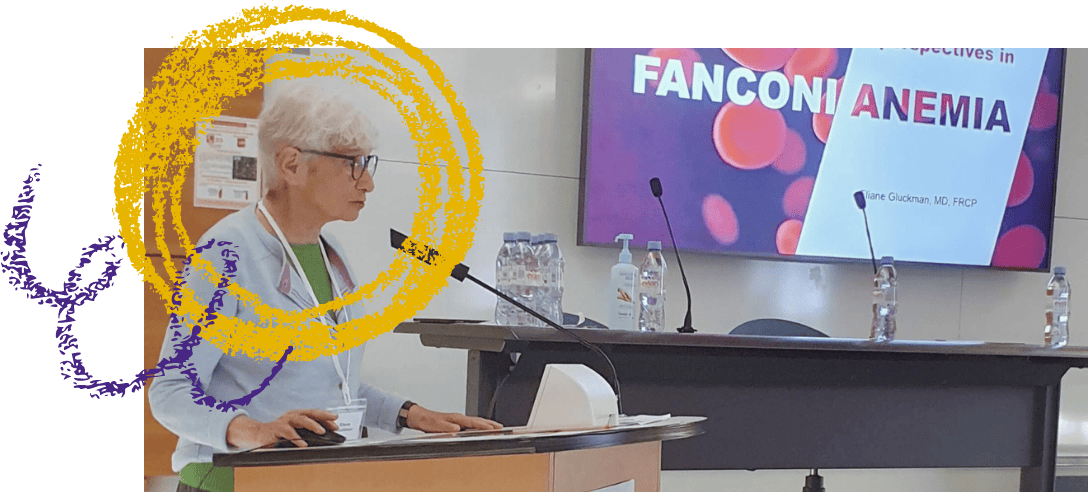
What was particularly significant was that there were a number of clinicians and scientists present working in areas of direct relevance to FA but who have not previously been involved with FA itself. Also notable was the presence of some younger clinicians and scientists who we hope will now have been inspired to work in the field of FA in the long term.
The feedback from the meeting has been extremely positive with a number of follow-up discussions now taking place as a result.
The respondents to our survey after the event have so far indicated overwhelmingly that the meeting gave them a clearer idea of how they could contribute to the field of FA and that it has encouraged them to collaborate more with others in Europe particularly in the areas of diagnostics, gene correction, transplantation, cancer prevention, and patient care in the transition from paediatric to adult clinics.
Our group of Patient Support Group Representatives from 14 European countries now have to ensure that we maintain the momentum that we have certainly created.